 Moonlight Shibas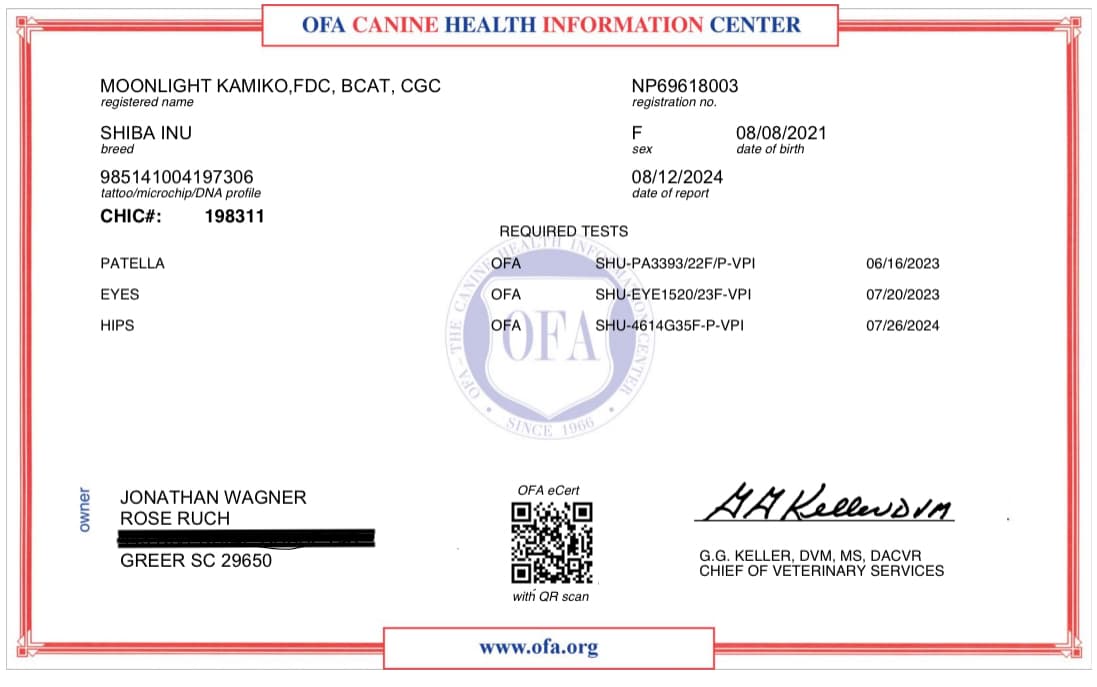
How to Read a CHIC Pedigree
When a responsible breeder says their dogs are "health tested," they are not handing you a marketing phrase. They are inviting you into a decades-long conversation about what lives in a bloodline. Learning to read that conversation is one of the most valuable things a puppy buyer can do, and it is not as complicated as it looks.
Why Health Testing Is Generational Data, Not a Checkbox
Every breed carries some inherited risk. Hip dysplasia, inherited eye conditions, cardiac anomalies, thyroid dysfunction: these are not random accidents. They run in families. When breeders test their dogs and record those results in a public registry, they are contributing to a dataset that future breeders and buyers can study.
A single test result tells you about one dog. A pedigree full of test results tells you about a whole family, and that is the difference between a snapshot and a story. The goal is not perfection in any one dog; it is a pattern of honest evaluation and thoughtful selection across generations.
What OFA Is and How to Use It
The Orthopedic Foundation for Animals (OFA) is the primary public registry for canine health testing in the United States. Founded in 1966 to address hip dysplasia, OFA now evaluates and records results for:
- Hips: radiographs graded by a panel of veterinary radiologists as Excellent, Good, Fair, Borderline, Mild, Moderate, or Severe
- Elbows: graded Normal or by degree of dysplasia
- Cardiac health: evaluated by a board-certified cardiologist
- Eyes: examined by a board-certified ophthalmologist (CAER exam)
- Thyroid: blood panel for autoimmune thyroiditis
- Patellas, spine, shoulders, and more: depending on what a breed's parent club requires
Any breeder who claims OFA certification should be able to give you their dog's registered name or OFA number. You can then go to ofa.org, click "Search OFA Records," and look it up yourself. The database is public. You do not need a login, and you do not need to take anyone's word for it.
What a CHIC Number Means
The Canine Health Information Center (CHIC) is a program run jointly by OFA and the American Kennel Club's Canine Health Foundation. A dog earns a CHIC number when it has completed all of the health tests required by its parent breed club and those results (whether passing or not) have been made publicly available.
That last part matters. A CHIC number does not guarantee clean results. It guarantees transparency. A dog with a CHIC number whose hips graded Fair still earned that number honestly because the breeder chose to publish the result rather than hide it. That kind of openness is exactly what you want to see.
DNA Tests vs. Physical Clearances: What Each One Proves
These two categories of testing answer fundamentally different questions.
DNA/genetic tests tell you whether a dog carries a mutation for a specific hereditary condition. A dog can be tested as:
- Clear (Normal/Normal): carries no copies of the mutation
- Carrier (Normal/Affected): carries one copy but is typically unaffected
- Affected (Affected/Affected): carries two copies and will likely show the condition
DNA tests are powerful for known single-gene diseases. A carrier dog is not a failed dog; it can be bred responsibly to a clear dog and produce no affected puppies. What matters is that both parents were tested and the pairing was made deliberately.
Phenotypic clearances (hips, elbows, eyes, heart) evaluate what is actually happening in the dog's body right now. A dog with excellent hips has excellent hips, but it may still carry polygenic risk it can pass on. Phenotypic and genetic tests are complementary, not interchangeable.
"Cleared" vs. "Tested" vs. "Excellent/Good/Fair"
Pay attention to which word a breeder uses.
- "Tested" means results exist. It says nothing about what those results were.
- "Cleared" typically means the dog passed the test at a satisfactory threshold, but always ask cleared by whom, for what condition, and when.
- "Excellent/Good/Fair" are the actual OFA hip grades. Excellent is the top tier. Good is solid. Fair is passing but represents a mild deviation: a breeder who consistently produces Fair hips is worth questioning about their selection choices.
How to Verify a Breeder's Claims Independently
The short answer: use ofa.org. Search by the dog's registered name or call number. Cross-reference what the breeder told you against what the public record shows. Look at both parents if possible. If a dog's OFA page is blank, the results may have been registered as "private," which means the owner chose not to make them public, and you should ask why.
Red Flags Worth Knowing
- "They're too young to test": hips and elbows are typically evaluated at age two, but other tests (cardiac, eyes, DNA) can be done earlier. If a dog is being bred before age two without any other testing completed, that is a concern.
- "The parents were healthy their whole lives": anecdotal observation is not a health clearance. Plenty of dogs live long lives while quietly passing heritable conditions to their offspring.
- Testing only one parent: both parents matter. A puppy inherits from two genetic lines, and an untested parent is an unknown variable.
- No OFA record you can find: breeders who genuinely health test want you to see the results.
What to Ask and Why the Lookup Matters
Before committing to any puppy, ask the breeder for:
- The registered names or OFA numbers for both parents
- Which tests were completed and when
- Whether either parent has a CHIC number
- For any DNA tests, the full panel name and results for both parents
Then look it up. Not to distrust the breeder, but because a breeder who tests their dogs expects you to verify it. The lookup itself signals that you are a serious buyer, and serious buyers attract serious breeders.
Health testing is the clearest window into how a breeder thinks about the future of their breed. When the records are transparent, current, and cover both parents, you are not just buying a puppy. You are buying into a line that someone has tended carefully. That is worth knowing before you ever visit a litter.